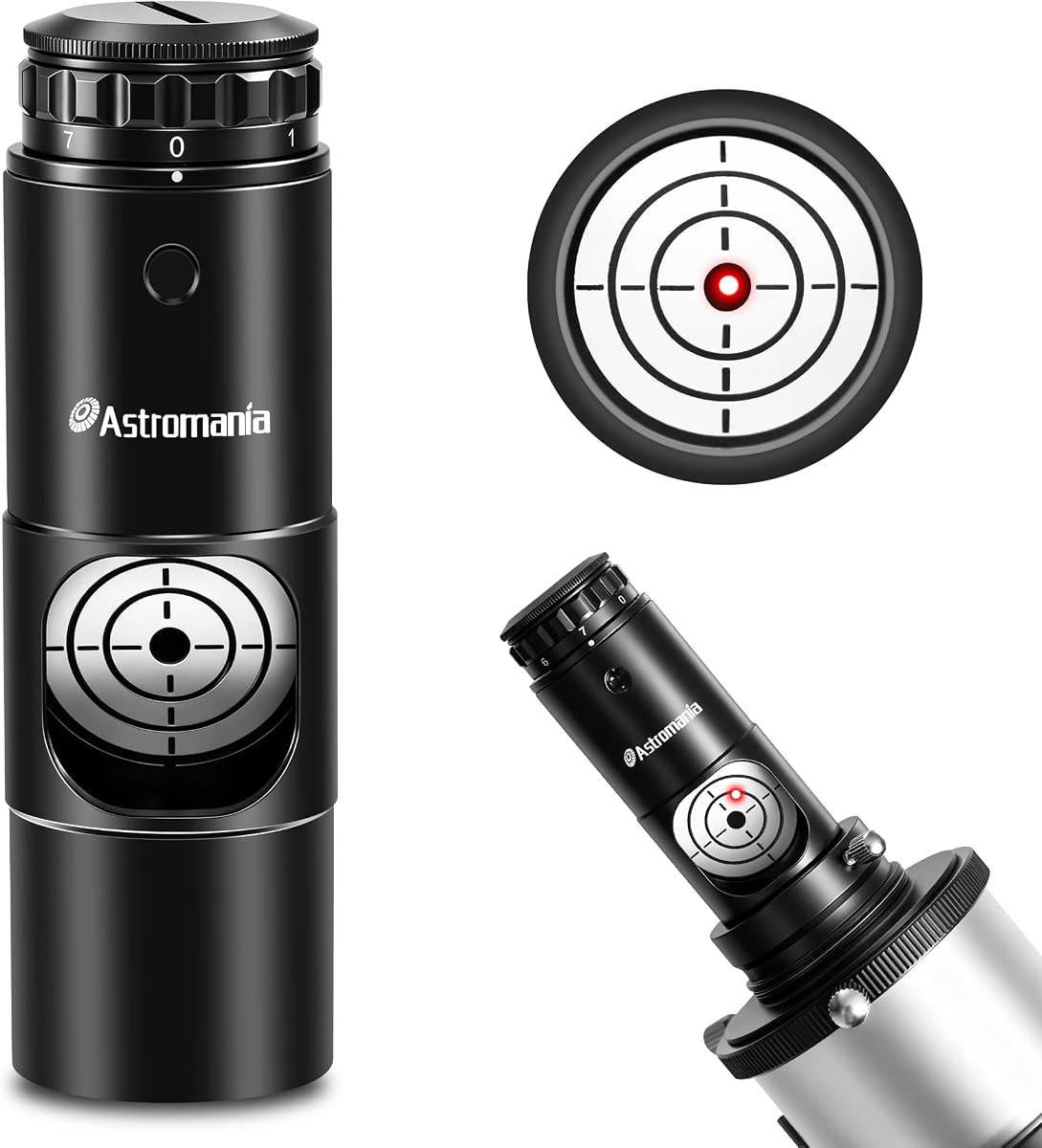
Astromania Laser Collimator 1.25 for
4.5Editor score
Fits 1.25 inch focusers
Seven brightness levels included
Durable metal construction
Aligning your telescope optics is crucial for achieving sharp images and maximizing performance. A laser collimator for telescope alignment simplifies this process by providing a clear visual reference for adjusting mirrors. Whether you are a beginner or experienced astronomer, having the right tool ensures your instrument performs at its best.
We evaluated ten leading laser collimator options based on build quality, calibration stability, and ease of use. Our comparison includes budget friendly models and advanced units with self-centering technology. Each product was analyzed for compatibility with standard focusers and overall reliability in various lighting conditions.
Each pick in this list highlights specific strengths such as adjustability brightness levels or included adapters. You will find options for Newtonian reflectors and some that work with other telescope types. Please note that prices and availability may change so check current listings before making your final purchase decision today.
4.5Editor score
4.7Editor score

As an Amazon Associate we earn from qualifying purchases.
This side by side comparison reviews ten laser collimator units designed for telescope alignment. We examine key specifications such as laser wavelength, adapter compatibility, and construction materials to help you choose the right tool for your observatory or portable setup.


The Astromania Laser Collimator stands out as a versatile tool for aligning Newtonian telescopes. It features a rating design that fits both standard 1.25 inch and 2 inch focusers thanks to a removable adapter. With a solid 4.5 rating from users, it is praised for making collimation quick and precise for clear images.
We may earn a commission when you buy through this link, at no additional cost to you.
This unit offers seven brightness levels for the red laser beam, allowing you to adjust intensity based on your environment. The wavelength ranges from 635 to 655 nm with an output power of 3.8 mW, complying with Class 3R safety standards. The metal body is anodized aluminum which resists wear and tear during transport or frequent use.
While the device is highly functional, it relies on a single CR2032 lithium battery which is included. Over time you may need to replace the battery to maintain performance. Additionally although it is pre calibrated you might need to adjust the internal screws if the laser drifts out of alignment after extended use.
Buyers looking for a reliable and affordable collimator for their Newtonian telescope should consider this option. It is suitable for beginners who need clear instructions and experienced users who want a tool that fits various focuser sizes. The combination of build quality and features makes it a strong choice for stargazers.
The removable 2 inch adapter allows this collimator to work with both 1.25 and 2 inch focusers. This flexibility means you do not need to buy separate tools if you upgrade your telescope setup.
Seven brightness levels let you match the laser intensity to your observing environment. Whether working in a bright room or under a dark sky you can ensure the beam is visible without being overwhelming.
We may earn a commission when you buy through this link, at no additional cost to you.
The Astromania Laser Collimator 1.25 is designed specifically for reflector telescopes with standard 1.25 inch focusers. It maintains the high quality and features of the dual size version but at a more accessible price. Users appreciate its ability to provide swift and precise collimation for sharper views.
We may earn a commission when you buy through this link, at no additional cost to you.
This collimator features a red laser beam with seven brightness levels to suit different light conditions. The wavelength is 635 to 655 nm with an output power of 3.8 mW ensuring safety and visibility. The body is made of premium metal with an anodized aluminum process to resist wear and tear.
One limitation is that it only fits 1.25 inch focusers which means it cannot be used directly with 2 inch setups without an adapter. The battery required is a CR2032 lithium cell which is included but may need replacement over time. However for standard setups it offers great value.
If you own a telescope with a 1.25 inch focuser and need an affordable tool this collimator is ideal. It is perfect for beginners who want reliable results without spending too much. The compact design allows it to be carried easily to dark sky sites.
The compact body fits naturally in your palm allowing smooth movement within 1.25 inch focusers. Its lightweight design makes it easy to carry to observing sites or store in a compact kit.
Constructed with durable metal and an anodized aluminum process this unit resists damage from daily use. This ensures it remains a reliable investment for long term stargazing needs.
We may earn a commission when you buy through this link, at no additional cost to you.
The SVBONY Laser Collimator is built to calibrate reflecting telescopes with both 1.25 and 2 inch adapters. It is designed to make alignment less boring and time consuming with accurate results in minutes. The metal body ensures it can withstand regular use at the observatory.
We may earn a commission when you buy through this link, at no additional cost to you.
It features a triple cemented lens which improves the stability of the red dot alignment. The beam has seven brightness levels allowing you to adjust it for different conditions. This quick alignment tool is much faster than manual collimators and is often recommended as a great gift.
The removable 2 inch adapter is a key feature if you plan to upgrade your telescope setup. However note that battery inclusion can vary by kit so check the product details before purchase. Over time the laser may drift and require minor adjustments to maintain precision.
For stargazers looking for a durable tool that works with multiple focuser sizes this collimator is a solid choice. It balances ease of use with performance making it accessible for new astronomers. The clear instructions help simplify the process of getting optimum performance.
The triple cemented lens design improves the stability of the red dot during use. This stability helps ensure that your alignment is accurate and consistent every time you use the tool.
The removable 2 inch adapter allows you to use this collimator on both 1.25 and 2 inch focusers. This means you do not need to buy a new tool if you upgrade your telescope optics.
We may earn a commission when you buy through this link, at no additional cost to you.
The SVBONY Red Laser Collimator Bundle comes with a telescope lens for enhanced viewing. It allows anyone to easily collimate reflector telescopes with removable adapters and metal construction. The inclusion of an eyepiece makes it a complete set for both collimation and observation purposes.
We may earn a commission when you buy through this link, at no additional cost to you.
This unit features a standard 1.25 inch 31.7mm fitting diameter compatible with many astronomical telescopes. The red laser beam has seven brightness levels suitable for different light conditions from dark to day. The output power is less than 1 mW complying with Class I laser safety standards.
The bundle includes a 62 degree aspheric eyepiece which gives a wide field of view for lunar and deep sky targets. However the current rating is N/A so user feedback is limited. The collimator itself is adjustable but requires careful handling to maintain factory calibration.
This bundle is ideal for those who want a combined tool for collimation and observing. The wide angle eyepiece provides an unforgettable lost in space feeling for various targets. Ensure you check compatibility with your focuser before purchasing to avoid issues.
The SVBONY 62 degree aspheric eyepiece gives maximum detail across the entire field of view. This super wide angle helps you see lunar and deep sky targets with greater definition.
The output power is less than 1 mW complying with Class I laser safety standards. This makes the device much safer for your eyes compared to higher power models.
We may earn a commission when you buy through this link, at no additional cost to you.
The Alstar Laser Collimator Alignment is designed for Reflector telescopes with 1.25 inch focusers. It comes fully adjusted but can be further adjusted if required. Users appreciate the precise instructions provided in German and English which help newcomers to amateur astronomy.
We may earn a commission when you buy through this link, at no additional cost to you.
It features a red laser collimation beam with seven brightness levels for visibility. The wavelength is 635 to 655 nm with an output power less than 5 mW. The unit is built with metal material and has a side window for viewing the reflected laser.
One important note is that the CR2032 Lithium Cell battery is not included. You will need to purchase this separately to operate the device. Despite this the sturdy design allows you to swiftly and precisely collimate your telescope with minimal effort.
If you have a Newtonian telescope with a 1.25 inch focuser this is a reliable tool. The step by step instructions make it simple for beginners to learn alignment. It is affordable and provides accurate results for clearer telescope images.
The side window allows a disk oriented at 45 degree with a central hole to be viewed. This feature lets you see whether the laser is reflected back on itself for accurate alignment.
Precise instructions in German and English guide you through the alignment process. Even if you are new to astronomy the step by step explanation makes setup simple and clear.
We may earn a commission when you buy through this link, at no additional cost to you.
The Alstar Laser Collimator Alignment for Marca Newtonian Telescopes 1.25/2 is a professional telescope alignment tool. It achieves precise optical collimation with a standard 1.25 inch fit and included 2 inch adapter. The laser comes pre-calibrated with three 120-degree adjustment openings for fine-tuning.
We may earn a commission when you buy through this link, at no additional cost to you.
It is constructed with durable metal to ensure long-lasting performance. The red laser beam features 7 adjustable brightness levels with a wavelength of 635 to 655 nm. The triple cemented lens provides stable beam projection for accurate reflection monitoring.
This model allows single-person telescope calibration within minutes which is helpful for remote observing sites. The battery replacement is simple via a rear screw cap. However some users have reported a slightly lower rating which may indicate quality variations.
For those who need a tool that works with both focuser sizes this collimator offers good value. The detailed instructions help ensure you can achieve optimal performance without frustration. It is suitable for beginners and experienced astronomers alike.
This tool achieves precise optical collimation for Newtonian and reflector telescopes. The advanced laser technology helps ensure your telescope is properly aligned for sharper images.
Initial sealed adjustments maintain calibration integrity while allowing user modifications when necessary. This ensures the tool stays accurate even after shipping or handling.
We may earn a commission when you buy through this link, at no additional cost to you.
The SVBONY Red Laser Collimator with Phone Adapter allows anyone to easily collimate reflector telescopes. It comes with a removable 2 inch adapter and metal material for long lasting use. The bundle includes a phone adapter that supports eyepiece diameters from 25 to 48mm.
We may earn a commission when you buy through this link, at no additional cost to you.
The red laser beam has 7 brightness levels to suit different light conditions. The output power is less than 5 mW which is safe for use. The phone adapter is compatible with many iPhone and Android models making it versatile for imaging.
While the collimator is effective the phone adapter is designed for 1.25 inch focusers mainly. It is not intended for 2 inch eyepieces but works with most optical devices. The phone clamping features an adjustable locking mechanism for stability.
This bundle is perfect for astrophotography beginners who want to align and capture images. The phone adapter allows you to use your smartphone to view targets through the scope. It simplifies the transition from visual observing to photography.
The phone adapter fits eyepiece diameter from 25 to 48mm and is compatible with many mobile phones. This lets you easily attach your device to the eyepiece for photography.
The clamping features an adjustable locking mechanism with a steel bolt to secure the phone. High density EVA pads protect the device during use and transport.
We may earn a commission when you buy through this link, at no additional cost to you.
The SVBONY SV197 Collimating Cheshire Eyepiece Bundle includes both a laser collimator and a Cheshire tool. It is useful for aligning refractor optics as well as Newtonian reflectors. The laser part allows anyone to collimate reflector telescopes with removable adapters.
We may earn a commission when you buy through this link, at no additional cost to you.
The Cheshire eyepiece is precision machined from aluminium with fine crosshairs. It has no batteries needed which is convenient for daytime alignment. The laser collimator features 7 brightness levels to suit different light conditions for alignment in dark and day.
This bundle offers a comprehensive solution for collimation. The Cheshire tool is best for secondary mirror collimation during the day while the laser works at night. The combination ensures you can maintain alignment under any light condition.
With a perfect 5.0 rating users are satisfied with the quality and results. It is a great option for those who want a complete collimation set. Having both tools ensures you can achieve accurate alignment consistently.
The Cheshire eyepiece is precision machined from aluminium with fine crosshairs and a clear bright mirror. It is easy to align and requires no batteries for use.
The laser collimator allows anyone to easily collimate reflector telescopes with 7 brightness levels. This ensures amazing alignment in dark and day for better views possible.
We may earn a commission when you buy through this link, at no additional cost to you.
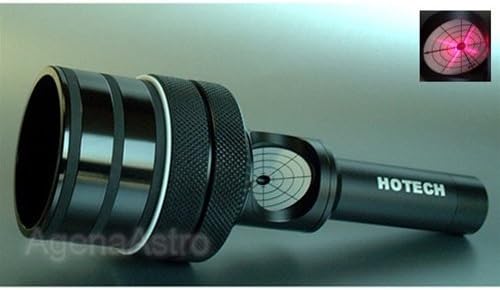
The HoTech SCA Laser Collimator separates itself with its innovative self-centering adapter technology. It solves the fundamental problem of slop in adapting mechanisms between the laser and telescope focuser. This ensures precise and repeatable installation in all brands of focusers.
We may earn a commission when you buy through this link, at no additional cost to you.
It comes with a patented 1.25 inch SCA Laser Collimator with a built-in Self-Centering Adapter. It fits both 1.25 and 2 inch focusers securely. The unit includes a CR123 battery and users manuals for Newtonian SCT and Star collimation.
Standard collimators often suffer from off-axis installation that destroys precision. The HoTech SCA prevents this by allowing the laser to be installed without slop. This makes it ideal for imaging sessions where alignment accuracy is critical.
For serious astronomers and photographers this premium tool is worth the investment. It ensures your optical axis is aligned correctly without introducing errors. The included manual guides you through all types of collimation for optimal telescope performance.
The mechanism allows precise and repeatable installation in all brands of focusers. This eliminates the gap that usually causes off-axis installation and loss of precision.
This collimator is an ideal precision instrument to collimate your Newtonian for imaging. It ensures the optical axis is aligned correctly for best results.
We may earn a commission when you buy through this link, at no additional cost to you.
The Ocal Pro V4.0 Electronic Collimator elevates your astronomy experience with cutting-edge technology. It is designed specifically for Newtonian and Schmidt Cassegrain telescopes. The built-in software-guided calibration circles enable quick and precise optical axis adjustments.
We may earn a commission when you buy through this link, at no additional cost to you.
Each unit comes factory-centered to pixel-level precision ensuring optimal baseline accuracy. The portable design allows for complete collimation functionality on-the-go. This is perfect for field adjustments and mobile astronomy setups where traditional tools are bulky.
The software interface makes it user-friendly for modern users. It delivers professional-grade collimation capabilities in a compact package. However user feedback is currently N/A so it may be a newer product in the market.
For those looking for high-tech solutions to align their telescope this tool is innovative. It simplifies the process with software assistance and high precision. It is a great option for tech-savvy astronomers wanting convenience.
Built-in software-guided calibration circles enable quick and precise optical axis adjustments. This helps you get factory-centered pixel-level accuracy easily.
The all-in-one design allows for complete collimation functionality on-the-go. It is perfect for field adjustments and mobile astronomy setups without extra gear.
We may earn a commission when you buy through this link, at no additional cost to you.
Choosing the right laser collimator requires understanding key factors such as focuser size, brightness, and build quality. This guide explains what to consider to ensure you get a tool that fits your telescope and budget.
Telescopes typically use 1.25 inch or 2 inch focusers. Ensure the collimator fits your focuser directly or comes with a removable adapter. Some tools support both sizes for future upgrades.
Check if the tool requires an adapter for your specific focuser. A dual-size option offers better long-term value.
Adjustable brightness allows you to see the beam in different lighting conditions. Look for collimators with multiple levels like 7 brightness settings.
Higher brightness helps in daylight but may drain battery faster. Balance visibility with power consumption.
Metal construction with anodized finishes resists wear and tear better than plastic. This ensures the tool stays sturdy during transport and field use.
Durable bodies protect the internal laser components. Metal is generally more reliable for long-term use.
Look for sealed adjustment screws to protect internal mechanisms from dust. Adjustable units allow you to recalibrate if the laser drifts.
Three 120 degree adjustment openings are standard for fine-tuning. Ensure these are easy to access and use.
Laser power should comply with safety classes like Class 3R or Class I. This protects your eyes from harmful exposure.
Check wavelength and output power details. Typical red lasers are around 635 to 655 nm.
Most units use CR2032 or CR123 lithium cells. Check if a battery is included or must be purchased separately.
Consider the battery life and availability. Standard CR2032 is widely available but may need frequent replacement.
Some bundles include eyepieces or phone adapters for imaging. Decide if you need these extras for your workflow.
A Cheshire eyepiece is useful for daytime collimation. A phone adapter helps with astrophotography setup.
Budget models start around $20 while premium ones with self-centering tech cost more. Determine what features you need before buying.
Higher cost often means better precision and durability. Balance your budget with performance expectations.
Insert the collimator into the focuser securely. Ensure it is seated evenly without any wobble or gap that could affect accuracy.
Turn on the laser and adjust brightness. Observe the dot on the primary mirror to align the optics step by step.
Store the collimator in a dry place and remove the battery when not in use. This preserves the battery and prevents internal corrosion.
Yes, a laser collimator is essential for aligning the mirrors in a Newtonian telescope. It helps you achieve precise optical alignment which results in sharper images and better performance. Without it, your views may appear blurry or distorted.
You should collimate your telescope each time you set up for observing. Transporting or moving the scope can throw the alignment off. Regular collimation ensures consistent results every time you look through the eyepiece.
Yes, you can use a laser collimator during the day by adjusting the brightness. However the laser beam may be harder to see in bright sunlight. For daytime alignment a Cheshire eyepiece is often a better alternative.
The difference lies in the focuser size they fit. A 1.25 inch collimator fits standard focusers while a 2 inch fits larger ones. Some models come with adapters for both to offer versatility.
Self-centering collimators like HoTech SCA are worth it for high precision needs. They eliminate the slop found in standard adapters ensuring perfect alignment. If you do imaging this extra cost pays off in image quality.
If the laser dot does not return to the center of the aperture after reflection it needs recalibration. You can use adjustment screws to fix this if the unit allows. Regularly check alignment to maintain accuracy.
We reviewed ten laser collimators ranging from budget-friendly models to premium options. The top picks include options with dual-focuser support and advanced self-centering technology.
Prioritize compatibility and build quality when choosing. A durable tool with adjustable brightness ensures you can align in various conditions and over years of use.
Remember that prices and availability change frequently. Check current listings to get the best deal for your needs today.