
JHS Pedals JHS Little Black Amp Box Signal Converter
4.6Editor score
Passive design requires no power
Compact sturdy construction fits anywhere
Retains amp tone at lower levels
This guide compares the top ten attenuator for tube amp models to help you choose the right device for lowering volume while maintaining tone quality.
Finding the right attenuator for tube amp setups is essential for guitarists who want full power without overwhelming volume. These devices let you crank your amp to get sweet distortion while keeping noise levels manageable for home or studio use.
We evaluated ten top-rated models based on power handling, impedance matching, tone preservation, and additional features like line outs or reactive loads. Each unit was analyzed for build quality, ease of use, and how well it maintains your amp's natural character under load.
Each pick below shows specific strengths for different budgets and needs, from budget boxes to premium recording solutions. Keep in mind that prices and availability can change over time, so check current listings before making your final purchase decision today.
4.6Editor score

4.5Editor score

4.4Editor score
The following comparison table outlines key specifications and features for each of the ten attenuator for tube amp models considered in this guide. Use this overview to quickly identify which unit matches your amplifier type and recording needs.



The Bugera POWER SOAK PS1 stands out as a robust passive attenuator capable of handling up to 100 watts of power. It receives a solid rating from users who appreciate its ability to tame loud tube amps while preserving tone integrity across various frequencies.
We may earn a commission when you buy through this link, at no additional cost to you.
Its multi-impedance input connectors allow seamless matching with 4, 8, or 16 ohm amplifiers, making it versatile for guitar and bass setups alike. The emulated mic output adds significant value by providing a direct line signal that mimics a miked cabinet.
While it lacks advanced features like footswitchable boosts or recording interfaces, the straightforward passive design ensures reliability and ease of integration into existing rigs. Some users note that the tone coloring might be minimal compared to reactive units.
This model is ideal for players needing a simple, cost-effective solution to reduce volume without sacrificing gain structure. It is a strong recommendation for home studios or rehearsal spaces where budget and power handling are primary concerns.
The ability to switch between 4, 8, and 16 ohm inputs ensures compatibility with nearly any tube amplifier speaker output configuration.
This feature allows direct connection to mixing consoles or audio interfaces, eliminating the need for physical microphones in recording scenarios.
We may earn a commission when you buy through this link, at no additional cost to you.
The JHS Little Black Amp Box is a favorite among guitarists seeking a no-nonsense way to control volume without altering tone. With a high rating, users confirm it retains the natural feel and response of their tube amp's front end effectively.
We may earn a commission when you buy through this link, at no additional cost to you.
Designed to sit within the effects loop, it controls the signal sent to the power section, allowing you to push the preamp for distortion while keeping master volume low. Its passive design means no power supply is needed, adding to its simplicity.
Although it lacks a dedicated line output for direct recording, it excels at its core job of volume reduction. Some users prefer adding a separate load box for recording, but for gigging or home practice, it delivers consistent results.
This unit is perfect for players on a tight budget who want reliable volume control. It is highly recommended for those who prioritize tone preservation and simplicity over advanced recording features.
Since it requires no external power, the unit is less prone to power supply noise and easier to transport for gigs.
Its compact footprint allows it to be mounted under a pedalboard or placed alongside other pedals without taking up space.
We may earn a commission when you buy through this link, at no additional cost to you.
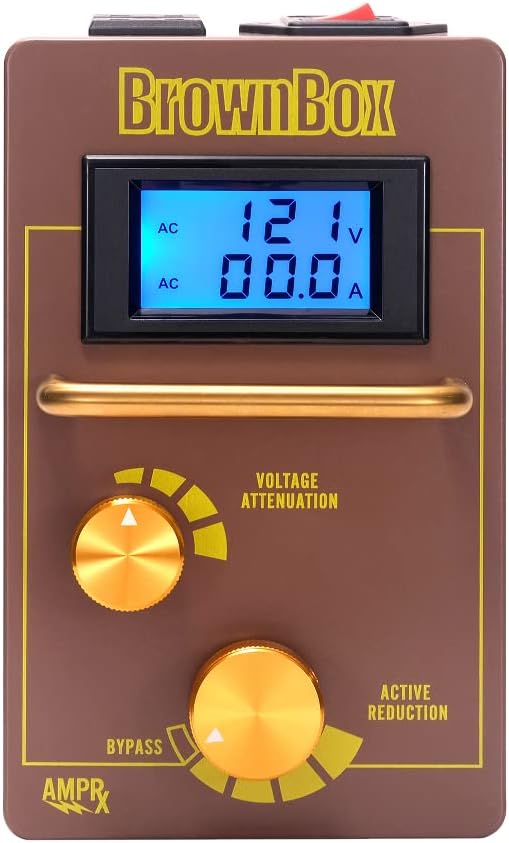
The BrownBox Tube Amplifier Input Voltage Attenuator offers a unique approach by adjusting the AC voltage supplied to the amp rather than attenuating speaker output. It has received perfect ratings from users who find it effective for reducing headroom and changing tonal response.
We may earn a commission when you buy through this link, at no additional cost to you.
With selectable input and output voltages plus a built-in LCD voltmeter, it gives precise control over the power delivered to your tube amp. This method allows you to run the amp at lower voltages, mimicking the sag and compression of a cranked amp at lower volume.
While not a traditional speaker attenuator, it achieves similar goals for players who want to alter the amp's behavior rather than just its volume. However, it requires careful setup and knowledge of voltage levels to avoid damaging equipment.
This unit is best suited for advanced users interested in voltage sag effects without loud volumes. It is a niche tool that delivers unique tonal results for those willing to experiment with power supply settings.
Lowering the voltage input creates natural compression and warmth similar to running an amp at high volume but quieter.
The integrated LCD voltmeter ensures you can monitor exact voltage levels to prevent accidental damage to your amplifier.
We may earn a commission when you buy through this link, at no additional cost to you.
The Tone King Ironman II Mini is designed for lower wattage amps, offering reactive load technology in a small footprint. Its rating reflects satisfaction with its ability to maintain dynamic feel and distortion character while reducing volume output.
We may earn a commission when you buy through this link, at no additional cost to you.
Featuring a footswitchable boost, it adds versatility for live performance by allowing quick level changes during play. The line output makes it easy to send a signal to a PA or recording interface directly, bypassing the need for speakers.
Its 30-watt limit makes it suitable for practice amps or small combo units, but higher wattage heads will require a larger model. The 8-ohm operation is standard but limits compatibility with 4 or 16 ohm setups without adapters.
This unit is an excellent choice for players with small tube amps seeking high-quality tone preservation. It balances size and functionality well for home use and small venue performances.
Unlike resistive loads, reactive loads mimic the behavior of real speakers to preserve high-frequency response and dynamics.
This feature allows you to temporarily increase volume or gain for solos without touching the amp controls.
We may earn a commission when you buy through this link, at no additional cost to you.
The Donner Amp Attenuator Pedal provides a budget-friendly solution for players wanting to control volume at the pedalboard. It receives positive reviews for maintaining tone clarity and allowing full preamp distortion at lower master volumes.
We may earn a commission when you buy through this link, at no additional cost to you.
True bypass design ensures your signal chain remains clean when the pedal is off, while the mute footswitch offers a quick way to silence the signal instantly. It runs through the FX loop, keeping the amp's power section manageable.
The need for a separate DC 9V adapter is a minor inconvenience but ensures consistent operation. While it lacks advanced recording features, it does the job well for volume reduction and tone shaping in home environments.
This pedal is ideal for beginners or those with limited budgets needing simple volume control. It is a practical addition to any pedalboard setup that includes a tube amp with an effects loop.
The mute function allows you to cut sound immediately for tuning or breaks without reaching for amp knobs.
When bypassed, the signal passes through without coloration, preserving the natural sound of your guitar and amp.
We may earn a commission when you buy through this link, at no additional cost to you.
The Two Notes Torpedo Captor is widely praised for combining a reactive load box with an attenuator in one compact unit. Its rating reflects strong satisfaction with its ability to provide consistent tone and reliable protection for tube amplifiers.
We may earn a commission when you buy through this link, at no additional cost to you.
The direct box output enables you to record directly into an audio interface with speaker simulation, eliminating the need for microphones. The 8 ohm output ensures safe loading for most tube amps, protecting them from open cabinet damage.
While it is optimized for 8 ohm systems, it is a robust choice for studio recording and live performance. Users appreciate the ability to send a clean DI signal while attenuating the speaker output to safe levels.
This hybrid unit is perfect for players needing a silent recording solution alongside volume control. It is highly recommended for home studios and gigging musicians who want professional results with minimal gear.
The built-in speaker sim captures cabinet tones accurately, allowing you to get finished sounds from your interface.
Using a load box ensures your amp always sees a speaker, preventing damage from running without a cabinet.
We may earn a commission when you buy through this link, at no additional cost to you.
The Universal Audio Ox Amp Top Box represents the pinnacle of tube amp attenuation and recording technology. Its rating stems from its ability to deliver studio-quality tones without the need for physical microphone placement.
We may earn a commission when you buy through this link, at no additional cost to you.
With analog reactive load technology and dynamic speaker modeling, it emulates speaker breakup and cone cry for authentic tone. Five attenuation levels give precise control over volume, from silent practice to full band performance.
The RIG control interface allows instant access to preset virtual mic and cabinet configurations, streamlining workflow. While the premium price is a consideration, the results justify the investment for serious recording and touring guitarists.
This device is best for professionals requiring top-tier recording capabilities directly from an amp. It is a comprehensive solution that replaces multiple pieces of gear in a single unit.
Front-panel controls let you switch between mic positions instantly, giving you diverse sonic options without moving microphones.
This advanced modeling captures subtle speaker behavior changes at different volume levels, maintaining realism.
We may earn a commission when you buy through this link, at no additional cost to you.
The Warm Audio Reamper Routing Hub serves as a specialized studio tool for reamping and managing signal paths. While rated for its design, it is appreciated for allowing detailed signal routing without sacrificing tone quality.
We may earn a commission when you buy through this link, at no additional cost to you.
It features a silent 50W power soak to manage output levels while recording, along with variable impedance control to tailor tone response. Independent preamp paths enable complex setups where signals can be split and recombined flexibly.
This unit is not designed for stage use but excels in controlled studio environments. Users value the ability to experiment with impedance and routing options during tracking sessions.
For producers and studio musicians looking to expand their reamping options, this hub is a valuable asset. It supports creative workflows that demand precise control over signal flow and levels.
Adjusting impedance allows you to change how the amp reacts to the signal, offering tonal variations without hardware swaps.
This feature allows you to route signals through different channels or effects chains independently for complex productions.
We may earn a commission when you buy through this link, at no additional cost to you.
The Tone King Ironman II 100-Watt is built to handle high-wattage tube amps without compromising dynamic response. Its rating reflects satisfaction with its performance in maintaining tone at low volumes while protecting the amplifier.
We may earn a commission when you buy through this link, at no additional cost to you.
Featuring analog cabinet simulation, it provides a line output that sounds like a miked cabinet, useful for silent recording. The presence switch adds extra tone shaping options to dial in the perfect sound for the situation.
Its bypass mode lets you use the unit as a pass-through when attenuation is not needed, preserving flexibility. The larger size is due to the power handling components, making it more suited for stationary setups.
This unit is ideal for owners of powerful tube amps who still want volume control. It is a reliable investment for players needing high power handling and professional recording capabilities.
This control allows you to adjust high-frequency response without touching the amp's settings, adding convenience.
Engaging bypass removes attenuation from the signal path for normal operation, saving wear on the internal components.
We may earn a commission when you buy through this link, at no additional cost to you.
The Boss WAZA Tube Amp Expander acts as a central command center for tube amp management, combining attenuation with speaker simulation. Its rating indicates strong performance in maintaining dynamic feel and distortion characteristics while supporting recording needs.
We may earn a commission when you buy through this link, at no additional cost to you.
Ten recallable rig settings allow you to store favorite setups for quick access, saving time during transitions. The built-in power amplifier enables you to drive speakers without a separate cabinet if desired.
Advanced features like MIDI I/O and impedance tuning provide deep control for studio and live environments. The price reflects its sophisticated capabilities, targeting serious musicians who need maximum flexibility.
This device is perfect for those seeking an all-in-one solution for attenuation and simulation. It offers unmatched versatility for professional musicians requiring precise control and recall functionality.
Store up to ten presets including impedance and load settings, ensuring you can reproduce tones accurately.
A built-in power amp allows you to run the Expander as a standalone speaker amplifier if needed.
We may earn a commission when you buy through this link, at no additional cost to you.
Selecting the right attenuator for tube amp involves understanding power handling, impedance matching, and desired features. This guide outlines the most important factors to consider before buying a unit.
The attenuator must be able to handle the wattage output of your amplifier. Choosing a unit with insufficient power handling can lead to overheating or damage over time.
Always select an attenuator rated equal to or higher than your amp's maximum wattage to ensure safety and longevity.
Tube amplifiers are sensitive to impedance mismatches, so ensure the attenuator supports your amp's output impedance. Look for models with multiple impedance options if your setup varies.
Matching impedance correctly prevents tone loss and protects your amp from potential damage caused by incorrect load.
Resistive loads are simpler but can color tone, while reactive loads mimic speaker behavior for more natural dynamics. Choose based on whether you prioritize simplicity or tonal accuracy.
Reactive models are generally preferred for players seeking to retain the authentic feel of their tube amp at lower volumes.
If you plan to record, check for line outputs and speaker simulation features. Units with built-in sims allow direct recording without microphones, saving time and space.
Prioritize units with line outputs if you need to send signals directly to audio interfaces or mixing consoles.
Passive units do not require power and are reliable, while active units often offer more features like footswitches and boost. Decide based on your need for power and feature set.
Passive attenuators are ideal for simplicity and reliability, while active units offer more control for live performance scenarios.
For live performance, consider units with footswitchable boosts or mute switches. These features allow real-time adjustments without touching the amp controls directly.
Look for models with intuitive controls and reliable footswitches if you need on-the-fly adjustments during gigs.
High-quality construction ensures durability, especially for touring musicians. Check for robust enclosures and reputable brands offering warranty coverage for peace of mind.
Investing in a well-built unit with warranty protection reduces the risk of long-term issues and ensures reliability.
Prices vary widely, from budget boxes to premium recording systems. Determine your budget and prioritize features that offer the most value for your specific use case.
Balance cost against features to find a model that meets your needs without overspending on unnecessary capabilities.
Start by connecting your amplifier output to the attenuator input, then connect the speaker to the attenuator output. Ensure impedance settings match your amp to prevent damage or tone issues.
Set your desired attenuation level using the controls on the unit, and test with your amp to find the sweet spot between volume and distortion. Use the line output for recording if your model supports it.
Keep the unit clean and free from dust, and store it in a dry place when not in use. Check cables regularly for wear to ensure consistent performance and longevity of your gear.
An attenuator reduces the volume of a tube amplifier while allowing the power stage to operate at high levels. This lets you achieve the amp's natural overdriven tone without producing excessive noise.
Some attenuators include load box functionality, but pure attenuators may not. If you plan to record silently, look for a combined unit or use a separate load box for safety.
Resistive attenuators may slightly change tone, but reactive models aim to preserve it. High-quality units are designed to minimize coloration and maintain your amp's character.
Attenuators are best designed for tube amps. Solid-state amps generally do not require them for tone reasons, but they can be used to reduce volume if necessary.
Check your amp's output impedance and set the attenuator to match. Most units have switches or dials to select 4, 8, or 16 ohm configurations for compatibility.
Many modern attenuators feature line outputs and speaker simulations for recording. This allows you to send a signal directly to an interface without using microphones on speakers.
Passive attenuators are simpler and reliable with no power supply needed. Active units offer more features but require power, so choice depends on your specific needs and preferences.
Keep it clean and dry, inspect cables for damage, and store it safely when not in use. Regular maintenance ensures long-term performance and prevents connection issues.
We have reviewed ten top attenuator for tube amp models ranging from budget boxes to premium recording solutions. Each unit offers unique benefits depending on your power needs and tonal requirements.
Prioritize power handling and impedance matching to protect your equipment, then consider features like line outputs or reactive loads for recording. Choose the model that fits your budget and usage scenario best.
Remember that prices and availability may change, so verify current details before purchase. Use this guide to find the right attenuator for your tube amp setup.