
ASUS Dual Radeon RX 9060 XT 16GB GDDR6 Gaming Graphics Card
4.7Editor score
16GB GDDR6 Memory
Axial-tech Fan Design
Dual BIOS Switch
This guide compares the top 10 GPUs for Comfyui to help you find the best graphics card for AI image generation and workflows.
Choosing the right GPU for Comfyui is critical for smooth AI image generation and workflow efficiency. A powerful graphics card ensures faster processing times and the ability to handle complex node setups without bottlenecks.
We compared ten top-rated GPUs based on memory capacity, architecture, cooling, and overall performance. Each product was evaluated for its suitability in AI tasks, compatibility with Comfyui, and value for creators.
Each pick highlights key strengths and trade-offs to help you decide based on your specific needs. Prices and availability change frequently, so verify current details before making a purchase decision.
4.7Editor score

4.3Editor score

4.6Editor score
The following table provides a side-by-side comparison of all ten GPUs selected for this guide. It highlights key specifications like memory size, architecture, and cooling to help you quickly identify the best fit for your Comfyui setup.




The NVD RTX PRO 6000 stands out as the ultimate choice for professional Comfyui workflows due to its massive memory and specialized AI features. With a 4.3 rating, it is designed for heavy-duty tasks like fine-tuning large models and handling complex node graphs.
We may earn a commission when you buy through this link, at no additional cost to you.
Its 96GB DDR7 ECC memory provides an immense buffer for loading high-resolution models and running multiple concurrent tasks. The 5th Gen Tensor Cores accelerate AI processing significantly, while PCIe Gen 5 ensures data transfer speeds match the GPU's capabilities.
While the price is steep and it comes in OEM packaging, the performance gains for serious creators justify the investment. The double-flow-through cooling design keeps the card stable under sustained 600W loads, ensuring reliability during long generation sessions.
This GPU is ideal for studios or professionals who need maximum capacity and stability for Comfyui. If budget is a concern, there are more affordable options, but nothing matches this level of raw power and memory.
The 96GB VRAM allows for seamless handling of massive AI models without resorting to system RAM offloading.
ISV certification ensures stability with creative software and workstation-specific drivers for error-free performance.
We may earn a commission when you buy through this link, at no additional cost to you.
The ASRock Intel Arc Pro B60 offers a compelling balance of memory and cost, making it a strong contender for Comfyui users on a budget. Its 24GB VRAM is substantial for the price point, enabling the loading of larger models without immediate bottlenecks.
We may earn a commission when you buy through this link, at no additional cost to you.
Built on Intel's Xe2-HPG architecture, it supports AI acceleration through dedicated XMX engines. The PCIe 5.0 interface ensures future-proof connectivity, while the blower-style design helps maintain cooling in multi-GPU setups or compact cases.
Its 3.9 rating reflects some variability in driver maturity compared to competitors, but it remains ISV certified for professional work. The 192-bit bus width provides decent bandwidth, though not as high as higher-end cards.
Consider this card if you need more VRAM than typical mid-range options but cannot afford flagship prices. It is particularly well-suited for Linux multi-GPU deployments where scaling is prioritized over single-card speed.
With 24GB of GDDR6, it fits more texture data and model layers into GPU memory for faster inference.
Optimized for Linux multi-GPU setups, allowing users to stack cards for increased total processing power.
We may earn a commission when you buy through this link, at no additional cost to you.
The ASUS Dual RTX 5060 Ti is a standout mid-range card that excels in Comfyui tasks thanks to its 16GB GDDR7 memory and Blackwell architecture. It earns a high 4.7 rating due to its reliable performance and efficient cooling design.
We may earn a commission when you buy through this link, at no additional cost to you.
Powered by DLSS 4 and advanced AI cores, it handles generative workflows with ease. The 2.5-slot design makes it compatible with smaller cases, while the dual BIOS allows users to switch between quiet and performance modes.
Axial-tech fans provide focused airflow to keep temperatures low during extended rendering sessions. The 0dB technology ensures silence during light tasks, making it a pleasant choice for home studios or shared workspaces.
This card is an excellent choice for hobbyists and semi-professionals who want strong AI performance without overspending. It balances power and price effectively, making it a popular pick for Comfyui users.
The Axial-tech fan design and 0dB technology ensure silent operation during light or moderate generation tasks.
Dual BIOS profiles let you toggle between quiet operation and maximum performance based on your needs.
We may earn a commission when you buy through this link, at no additional cost to you.
The GIGABYTE RTX 5080 is a premium powerhouse designed for users who demand top-tier performance in Comfyui. With a 4.6 rating, it combines advanced Blackwell architecture with robust cooling to deliver consistent, high-speed AI generation.
We may earn a commission when you buy through this link, at no additional cost to you.
Its 16GB GDDR7 memory offers high bandwidth, ensuring rapid data access during complex node operations. The WINDFORCE cooling system maintains optimal temperatures even under heavy loads, preventing thermal throttling during long sessions.
PCIe 5.0 support ensures the card can leverage the latest motherboard features for maximum data throughput. While expensive, the performance gains justify the cost for professionals who rely on speed and reliability daily.
This GPU is best for advanced users who need the fastest possible generation times and have a powerful system to support it. It represents the high-end of the consumer market for Comfyui compatibility.
The WINDFORCE cooling system uses multiple fans and heat pipes to dissipate heat efficiently under load.
GDDR7 memory provides faster bandwidth than previous generations, accelerating texture and model loading.
We may earn a commission when you buy through this link, at no additional cost to you.
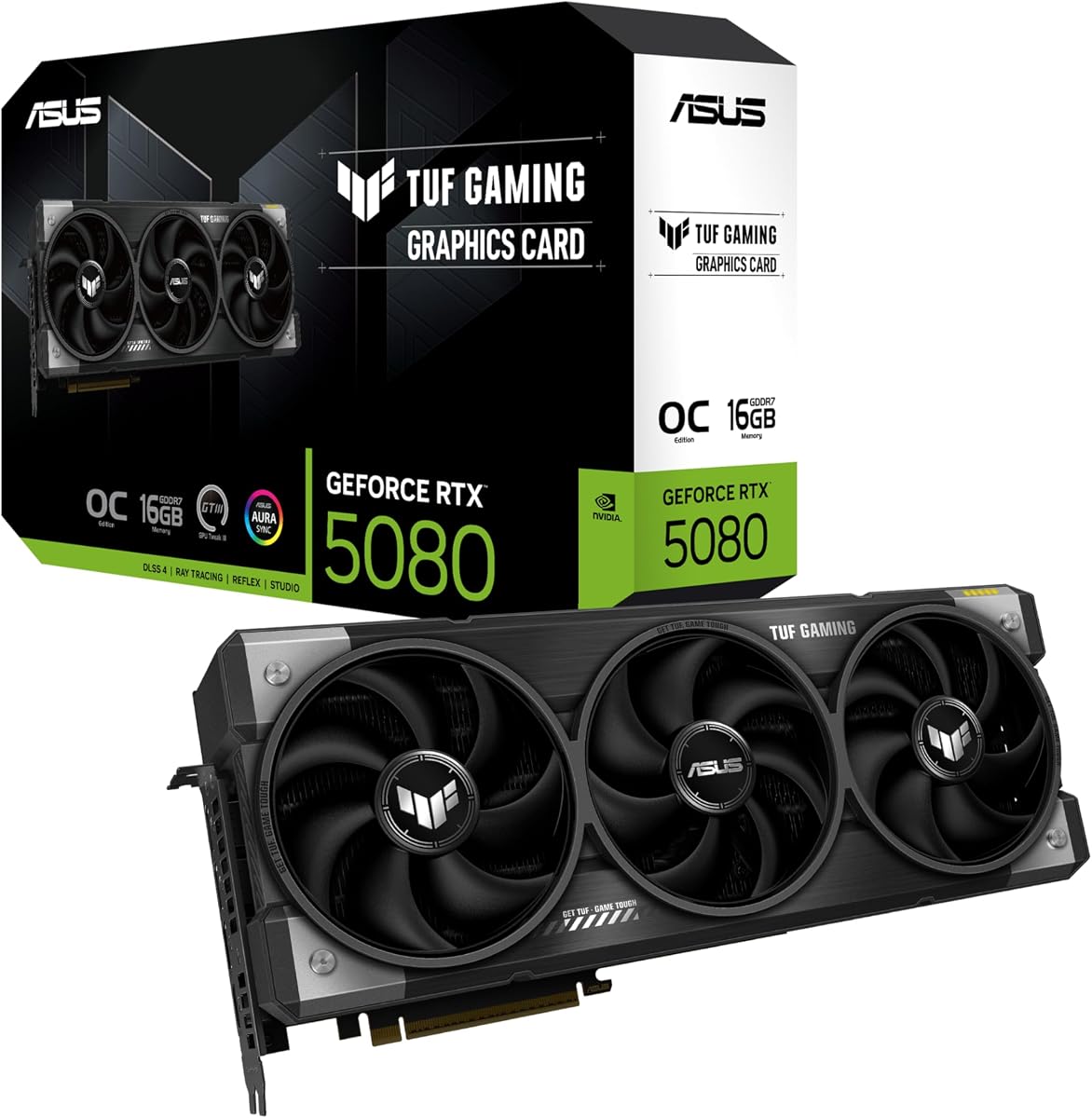
The ASUS TUF RTX 5080 emphasizes durability and longevity alongside raw performance, making it a reliable choice for daily Comfyui work. Its 4.6 rating reflects consistent performance and a build quality designed to withstand heavy usage.
We may earn a commission when you buy through this link, at no additional cost to you.
Military-grade components and protective PCB coating ensure the card lasts longer, even in challenging environments. The phase-change GPU thermal pad offers better thermal performance than traditional paste, keeping boost clocks stable under stress.
With a 3.6-slot design, it requires a larger case, but the improved airflow results in quieter and cooler operation. GPU Tweak III software provides intuitive controls for tuning performance to match specific workflow requirements.
Ideal for professionals who need a card that won't fail during critical projects, this option balances durability with top-tier specs. It is a solid investment for those who prioritize reliability over initial savings.
Phase-change thermal pads last longer and conduct heat better than standard paste, ensuring stable performance.
Components are tested for extreme conditions, providing greater resilience against dust, heat, and moisture.
We may earn a commission when you buy through this link, at no additional cost to you.
The GIGABYTE RX 9070 XT offers a strong alternative for Comfyui users who prefer AMD hardware. With a 4.7 rating and 16GB of GDDR6 memory, it provides a capable platform for generative tasks and AI inference.
We may earn a commission when you buy through this link, at no additional cost to you.
Its WINDFORCE cooling system keeps the card running cool and quiet, while PCIe 5.0 ensures high data bandwidth for the latest systems. The server-grade thermal conductive gel further enhances heat dissipation during prolonged use.
While AMD's support for certain AI workloads can vary, this card's raw power and memory capacity make it a viable option for many workflows. It is also an attractive choice for those building a high-end system on a budget.
Choose this card if you value performance and value and are comfortable managing GPU settings and drivers. It is a versatile option that balances gaming and creative capabilities effectively.
Server-grade thermal gel ensures heat moves efficiently from the core to the heatsink for better cooling.
Support for PCIe 5.0 allows faster communication with the CPU, reducing bottlenecks in data-heavy tasks.
We may earn a commission when you buy through this link, at no additional cost to you.
The ASUS Dual RX 9060 XT earns the Best Budget badge for its excellent balance of price and capability in Comfyui. With a 4.7 rating and 16GB of GDDR6 memory, it handles most generative workflows without breaking the bank.
We may earn a commission when you buy through this link, at no additional cost to you.
Its 2.5-slot design fits into smaller cases, making it ideal for compact builds. Axial-tech fans deliver focused cooling, while 0dB technology ensures silent operation during lighter tasks like browsing or minor adjustments.
While it may not match the speed of flagship cards, it offers strong value for entry-level AI users. The dual BIOS switch allows toggling between performance and quiet modes, adding flexibility to the user experience.
This card is perfect for beginners or those building a secondary machine for experimentation. It provides enough power to learn and create with Comfyui without a heavy financial commitment.
The 2.5-slot form factor and 0dB tech make it perfect for smaller or quieter desktop setups.
At a lower price point, it still offers 16GB of VRAM, a key requirement for many AI models.
We may earn a commission when you buy through this link, at no additional cost to you.
The ASUS TUF RTX 5070 offers a balanced combination of memory, performance, and durability. With a 4.7 rating and 12GB GDDR7, it handles many Comfyui tasks efficiently while maintaining strong build quality.
We may earn a commission when you buy through this link, at no additional cost to you.
Military-grade components and phase-change thermal pads ensure long-term reliability. The 3.125-slot design and Axial-tech fans provide ample airflow for stable performance under load.
GPU Tweak III software simplifies tuning, allowing users to optimize the card for specific workloads. It is an excellent middle ground for users who want better than mid-range performance without flagship costs.
This card is well-suited for general creators who want reliable performance for daily work. Its balance of features makes it a versatile choice for various Comfyui projects.
Military-grade parts and protective coatings help the card withstand stress and environmental factors.
GPU Tweak III allows easy performance adjustments and monitoring for optimal workflow efficiency.
We may earn a commission when you buy through this link, at no additional cost to you.
The ASUS Dual RTX 5050 is designed as an entry-level option for Comfyui users who need basic AI capabilities. With a 4.3 rating and 8GB of GDDR6 memory, it supports lightweight workflows and simpler node setups.
We may earn a commission when you buy through this link, at no additional cost to you.
Its SFF-ready 2-slot design makes it ideal for small cases, while Axial-tech fans maintain cooling efficiency. 0dB technology ensures quiet operation, making it a good fit for shared environments.
While the 8GB VRAM limits running very large models, it is sufficient for learning and experimenting with Comfyui. Dual BIOS allows switching between profiles to prioritize efficiency or performance.
This card is best for beginners or secondary systems where high-end performance is not required. It offers a cost-effective way to start using Comfyui without significant investment.
The SFF-ready 2-slot build fits easily into small PC cases, perfect for home or office setups.
0dB technology stops fans during low loads, keeping noise levels minimal during light tasks.
We may earn a commission when you buy through this link, at no additional cost to you.
The PNY RTX 5060 provides a compact and affordable option for Comfyui users. With a 4.4 rating and Blackwell architecture, it delivers solid entry-level performance for AI tasks in smaller systems.
We may earn a commission when you buy through this link, at no additional cost to you.
Its compact design opens up possibilities for various PC sizes, from small form factors to standard towers. Dual-fan cooling ensures heat is efficiently dissipated, while overclocking out of the box adds extra performance.
VelocityX software allows easy control over performance and monitoring, making it user-friendly for beginners. While limited to 8GB of memory, it remains capable for basic generation and experimentation.
This card is an excellent fit for small builds or budget-conscious creators starting with Comfyui. It offers a simple, effective solution without sacrificing key features like AI cores and modern architecture.
The dual-fan compact design fits well in smaller cases, expanding build options for limited spaces.
VelocityX software provides intuitive control over fan curves and performance for easy tuning.
We may earn a commission when you buy through this link, at no additional cost to you.
Selecting the right GPU involves weighing memory, architecture, cooling, and budget to match your Comfyui workflow needs. This guide outlines key factors to help you make an informed decision.
VRAM is the most critical factor for Comfyui because it determines the size of models you can run without slowdowns. Larger models require more memory to load textures and intermediate data directly on the GPU.
Aim for at least 16GB of VRAM for professional workflows, though 24GB or 96GB offers more flexibility for advanced users.
Modern architectures like NVIDIA Blackwell or AMD Radeon RX include dedicated AI accelerators that speed up generative tasks. These cores handle matrix calculations and inference more efficiently than older designs.
Prefer GPUs with latest-gen Tensor or XMX engines for faster generation and better support for new Comfyui features.
Memory bandwidth affects how quickly data moves between VRAM and GPU cores, impacting overall generation speed. Higher bandwidth ensures smoother performance during complex node graphs or multi-step processes.
Look for GDDR7 memory or wide bus widths like 256-bit for optimal data transfer speeds.
AI workloads can push GPUs for extended periods, so effective cooling is essential to prevent thermal throttling. Good cooling maintains stable clock speeds and extends the lifespan of the hardware.
Choose cards with advanced thermal designs like phase-change pads or multi-fan systems for sustained performance.
PCIe Gen 5 ensures maximum bandwidth for data transfer between the CPU and GPU, reducing bottlenecks in large workflows. While PCIe Gen 4 is sufficient, Gen 5 future-proofs your build for upcoming advancements.
Verify motherboard compatibility if you plan to use the latest PCIe standards for best results.
High-performance GPUs often need substantial power, so ensure your PSU can handle the card's TDP and connectors. Insufficient power can lead to instability or system crashes during heavy generation tasks.
Check that your PSU meets the wattage and connector requirements before purchasing a flagship GPU.
The physical size of the GPU matters if you use a small case or multi-GPU setup. Ensure the card fits your chassis slots and clearance to avoid installation issues.
For small builds, consider 2.5-slot or compact designs that maintain performance in limited space.
Stable drivers and regular updates are vital for smooth Comfyui operation, especially when using custom nodes or libraries. Professional-grade cards often come with certified drivers that enhance stability.
Choose brands known for reliable software support to minimize crashes and compatibility problems.
To get the best performance, keep your GPU drivers updated through the manufacturer's software like NVIDIA GeForce Experience or AMD Adrenalin. This ensures compatibility with the latest Comfyui features and AI libraries.
Monitor your GPU temperatures using tools like GPU Tweak III or VelocityX to ensure your cooling system is working correctly. If temperatures exceed safe limits, consider cleaning dust from fans or improving case airflow.
Avoid overclocking beyond safe limits unless you understand the risks. Use conservative settings for stable workflow operation and always test changes with a small workload before committing to full use.
At minimum, you should have 8GB VRAM for basic use. For comfortable generation of larger models, 16GB is recommended, and 24GB or more is ideal for professional workflows involving high-resolution outputs.
Yes, AMD GPUs are supported through ROCm and other community ports. However, NVIDIA cards generally offer broader compatibility and optimized features for Comfyui workflows, making them the preferred choice for most users.
PCIe Gen 5 doubles bandwidth compared to Gen 4, reducing bottlenecks during high data transfer tasks. This improves overall responsiveness in complex workflows, though the difference may be minimal for basic usage.
Check the GPU's TDP and recommended PSU wattage in the product details. Ensure your PSU has the required power connectors, like 12VHPWR, and offers a margin above the GPU's needs for stability.
Prioritize memory first, as insufficient VRAM will halt generation regardless of speed. Once you have enough VRAM, focus on clock speed and bandwidth for faster performance.
Workstation GPUs offer more VRAM and stable drivers, which benefit professional workflows. Gaming cards are more cost-effective and perform well for most Comfyui users, making them a great choice for hobbyists.
In summary, the top picks offer a range of options from the high-capacity NVD RTX PRO 6000 to the budget-friendly ASUS Dual RX 9060 XT. Each provides distinct advantages depending on your workload and system requirements.
Prioritize VRAM and architecture to ensure future compatibility with evolving Comfyui features. Balancing performance with your system's power and cooling capabilities is key to achieving reliable results.
Always check current prices and availability before purchasing, as market conditions can change rapidly. Choose the card that aligns best with your specific goals and budget constraints.